Positioning in one sentence means saying, briefly and precisely, who you work for, which problem you solve for those people and why they should come to you for it. Sounds small. It isn’t.
Plenty of home pages open with something like “Your partner for holistic solutions”. A visitor knows no more afterwards than before. A clear positioning statement forces you to make decisions that make your whole website easier from then on. All you need is a formula with four building blocks, a few examples to compare against and someone outside your field for a quick test.
Key points at a glance
- A good positioning statement names your target group, the problem, your approach and the result. If one block is missing, the reader fills the gap with guesswork.
- The sentence is a working tool for you first. On your website it usually becomes the headline and subline, rarely word for word.
- What makes it interchangeable: lists of everything you can do, empty phrases like “holistic” and jargon that only your industry understands.
- A simple test shows whether it works: someone outside your field reads it once and then tells you who you work for and what they would get from you.
Why should your positioning fit into a single sentence?
A single sentence forces you to choose. A paragraph has room for five target groups and eight services, a sentence doesn’t. That choice is exactly what a visitor needs when they decide within seconds whether they are in the right place. The sentence is the condensed answer to their question: can you help me?
Imagine someone at a party asks what you do for a living. You have about two sentences before the conversation moves on. Say “I do consulting for businesses” and you get a polite nod. Say “I help medical practices take bookings online so the phone doesn’t block the whole morning” and you will usually get a follow-up question.
Your website doesn’t get that follow-up question. The visitor stays or clicks away, and you never find out why.
The sentence doesn’t come out of nowhere either. If you have collected your customers’ buying triggers and objections (we show how in Ideal customers), the material is already in front of you. In a website concept, positioning is the building block between ideal customer and page structure. Only once you know who you are talking to and what you promise them do you know which pages your website needs and what goes at the top of the home page.
Which formula helps you find your positioning statement?
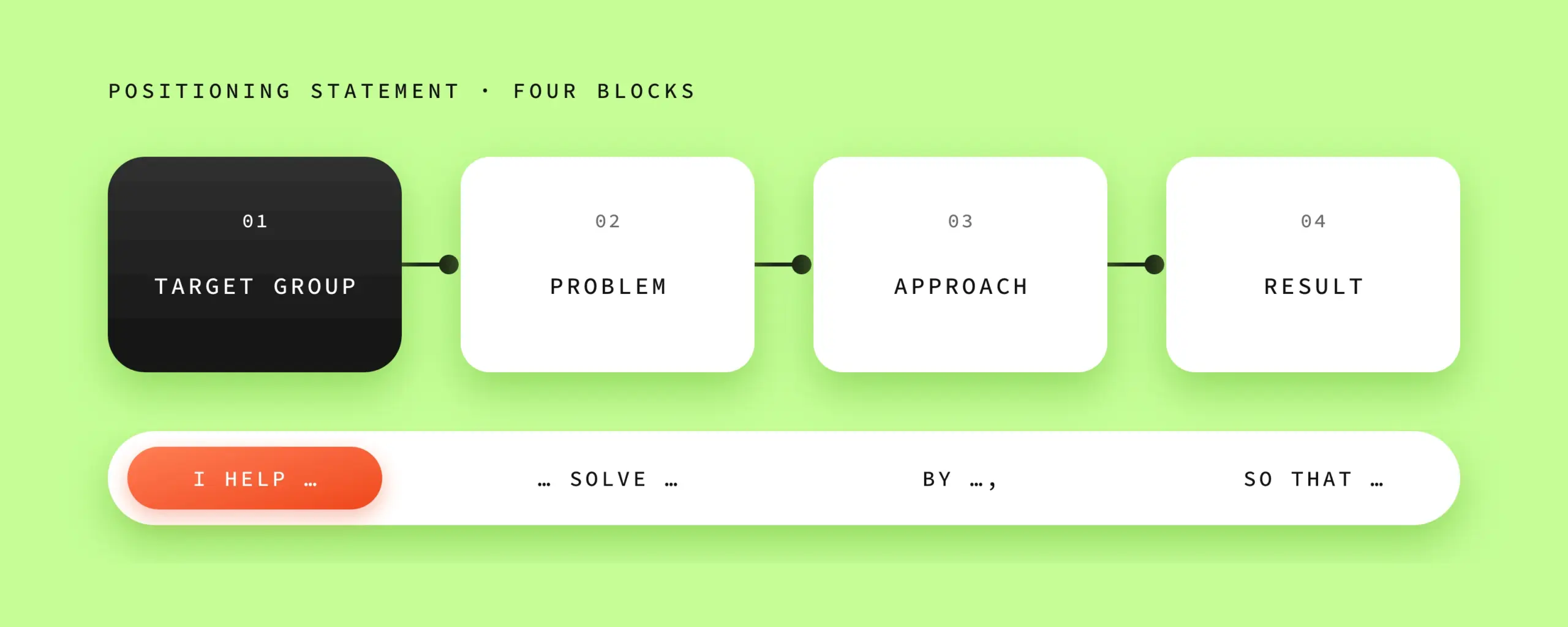
A good formula to start with has four building blocks: “I help [target group] [solve a problem or reach a goal] by [your approach], so that [result that changes for them].” It is scaffolding for your thinking. Your finished sentence can sound different, as long as all four blocks are in it.
| Building block | Guiding question | Too vague | Specific enough |
|---|---|---|---|
| Target group | Who has the problem most urgently and can pay for the solution? | “businesses” | “physiotherapy practices with their own team” |
| Problem or goal | What costs these people time, money or nerves today? | “master challenges” | “find new patients without waiting for referrals” |
| Your approach | How do you work, what do you do differently from others? | “with tailored solutions” | “with marketing only for practices that describes complaints the way patients search for them” |
| Result | What is visibly different for the client afterwards? | “more success” | “even the off-peak slots in the diary are booked” |
Start with the target group, even if this is the decision you find hardest. Once your target group is set, look at past enquiries from people in that group and talk to some of them in person. That way you quickly learn which problems they really have. Your approach then describes how you help them with these problems and what you do differently. Write the result last: what has changed for your client? Put it the way they would tell a friend, simply and without jargon.
If you work with a team, write “We help …”. If you work on your own, “I” is perfectly fine. With freelancers and sole traders, clients often buy the person.
What does a good positioning statement sound like for a coach, a law firm and a service provider?
A good sentence sounds like a specific person with a specific problem. The three examples below are made up so you can see how it works. On the left is a sentence like the ones you find on many websites. On the right is the same offer after someone has taken the four building blocks of the formula seriously.
| Offer | Before | After |
|---|---|---|
| Business coach | “I support people holistically in their personal and professional development.” | “I help team leaders in their first year in charge prepare difficult conversations, so they address conflicts before they escalate.” |
| Employment law firm | “Your competent law firm for all legal questions.” | “We advise care services on dismissals and formal warnings, so a formal error doesn’t only come to light at the employment tribunal.” |
| IT service provider | “Tailor-made IT solutions for SMEs.” | “We look after IT and data protection for medical practices, so the practice software runs when the waiting room is full.” |
Take a closer look at the right-hand column: every one of these sentences excludes people. The coach no longer speaks to everyone who wants to develop. Instead, the team leader who has their first staff review coming up recognises themselves straight away. They keep reading because the sentence describes their situation.
Notice also what is missing from the “after” sentences. No “competent”, no “tailor-made”, no list of services. The expertise shows in how precisely someone can name the problem.
Which mistakes make your positioning statement interchangeable?
You will find three mistakes on many websites: the sentence tries to speak to everyone, it is made of words without content, or it speaks the language of the industry instead of the customers’. The result is the same every time. The visitor can’t tell whether they are meant, and keeps looking.
The do-it-all sentence
“We offer web design, SEO, social media, photography and consulting for businesses of every size.” The fear behind a sentence like this is understandable. Every service you cut feels like a lost job. To the visitor, though, the list looks like a market stall, and they wonder what you are actually good at.
Your services belong on your service pages. The positioning statement names what you want to be found and recommended for.
Empty phrases
“Holistic”, “individual”, “tailor-made”, “with passion”: these words appear on so many pages that readers skip them. A quick check is the opposite test. Would a competitor claim the opposite? Nobody writes “We work off the peg”. What nobody disputes doesn’t set you apart either.
Try a quick experiment. Open the websites of three competitors, copy the first sentence at the top of each home page and swap the company names. If you can still tell the difference, at least one of them has real positioning.
Your industry’s jargon
A tax adviser writes “structuring advice for business succession”, an IT service provider “managed services with SLA”. To colleagues that is precise. Your client thinks in their own words, for example: “What happens with tax when my daughter takes over the business?”
You will find these phrases in emails, enquiries and notes from first conversations. We show how to collect them systematically in Ideal customers.
How do you test whether visitors understand your sentence straight away?
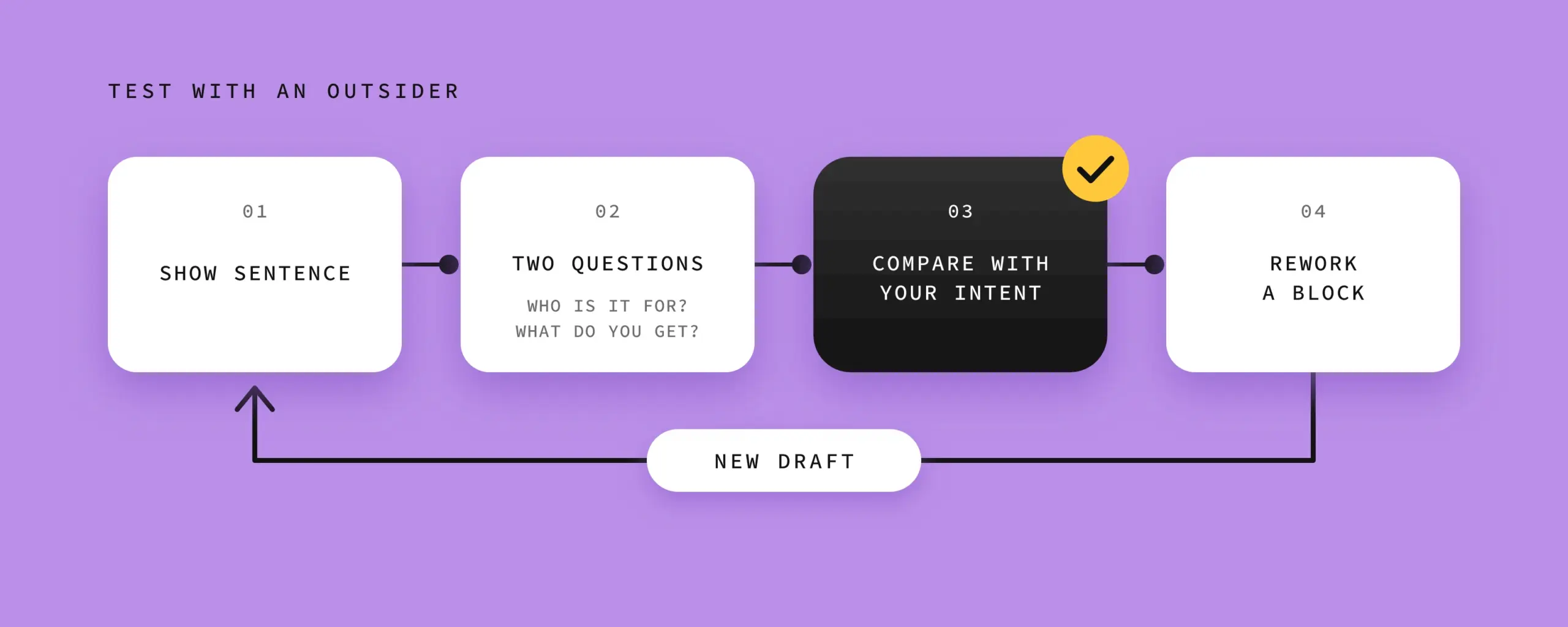
Have someone outside your field read your sentence once, without explanation. Then ask two questions: who does this person work for? What do you get from them? If both answers match what you meant, the sentence works. If one is off, a building block is missing or hiding behind jargon.
This is how the test works:
- Write the sentence in a message, without a logo and without any explanation.
- Give it to someone outside your industry, a friend for example. Read it once, then put it away.
- Ask: “Who is this for?” and “What do you get?” Write the answers down word for word.
- Finally ask: “Can you think of anyone you would recommend this to?”
- Repeat this with two or three people and rework the building block that was misunderstood most often.
The last question reveals more than it seems. If the other person names someone straight away, your target group is tangible. If you only get a shrug, your sentence describes an industry rather than a person.
You can run the same test with your home page: show it to someone for five seconds and then ask the same two questions. If the answers differ from those for the sentence alone, your page doesn’t match your positioning. That is one of the common reasons why a website isn’t bringing enquiries.
Where do you use the positioning statement on your website?
The sentence is a tool for you first. On the home page you usually spread it over two lines: the headline names target group and result, the subline shows your approach. You don’t have to use it word for word. But every statement at the top of the page should trace back to it.
For the coach from the example, it could look like this:
- Headline: “Coaching for new managers who address conflicts before they escalate.”
- Subline: “I prepare difficult conversations with you, so you come across clear and confident in your first year in charge.”
If you already have a tagline, it also works the other way round. On our own home page, the headline is deliberately brand: “Made to stand out. Smart by design.” The subline directly below carries the positioning: “High-converting websites and smart automations for professionals and SMEs.” This lets the headline show attitude, while the subline says straight away who we work for and what you get from us.
After that, the sentence turns up in other places, adapted each time. The first paragraph of your About page picks it up, as does the meta description of your home page that appears in search results. It helps outside your website too: in your LinkedIn profile or in the round of introductions at a networking event.
Above all, the sentence decides which pages your website needs. If it names one target group and one core problem, a lean page structure follows from it. In the next step, it becomes the real headline in your wireframe.
Frequently asked questions about positioning in one sentence
Will I lose work if I narrow my positioning?
Mostly you lose enquiries that wouldn’t have been a good fit anyway. Narrow positioning doesn’t stop you from taking on other clients. It only decides who your website speaks to directly. If someone outside your target group comes via a referral, you still decide whether to take the job. People who recognise themselves in the sentence, on the other hand, are more likely to get in touch.
What is the difference between positioning and a slogan?
The positioning statement describes factually who you solve what for, and with what result. It is an internal tool and can be longer and plain. A slogan is a short, memorable line for the outside world. A good slogan can be derived from the positioning. The other way round rarely works, because a slogan carries too little information.
Can my positioning statement name more than one target group?
Two closely related target groups with the same problem work, such as physiotherapy and occupational therapy practices. If the groups have different problems, write one sentence per target group and give each its own page. Your home page then features the group you want to do most of your work with, and clear navigation takes the others to their page.
How often should you review your positioning statement?
Look at it again whenever your offer or your ideal customers change, and otherwise about once a year. Enquiries that don’t fit are a good trigger: if people you didn’t mean keep getting in touch, your sentence describes something other than you think. Then run it through the test from this article again.
Conclusion
Your positioning statement is finished when someone outside your field can say, after reading it once, who you work for and what they would get from you. It usually takes several drafts to get there.
Take twenty minutes today, fill in the four building blocks of the formula and put the sentence next to the headline on your home page. If they tell different stories, you know where to start. If you would like a second opinion, use our free website check: in a video review you get, among other things, an answer to whether visitors at the top of your page understand what you offer and who it is for.