A website brief is a short written description of your project that sets out the current situation, goal, target audience, scope, budget range, timeline and responsibilities, so that web designers can give you comparable quotes. You write it before you send your first enquiry. Without a brief, every provider fills the gaps with their own assumptions. You then end up comparing quotes that describe different projects, and the cheapest price is often just the smallest assumption.
Key points at a glance
- A brief makes quotes comparable, because every provider works from the same information.
- It covers your situation, goal, ideal clients, core offer, scope, budget range, timeline, who decides and what already exists.
- Describe the problem the website should solve. Number of pages, design and technology are better worked out together with your provider.
- Give a budget range. Without one, every provider prices a different scope.
- Ask every provider the same questions, for example whether strategy and copy are included and what happens after launch.
Why is a brief worth writing before you contact web designers?
A brief is worth writing because every quote rests on assumptions. If all you write is “We need a new website, how much does it cost?”, each provider calculates a different scope. The quotes then differ in price because they describe different services. With a brief, you end up comparing services.
Imagine three quotes that sit far apart between the lowest and the highest price. The first assumes five pages and your finished copy. The second includes a concept, but no copy. The third plans in strategy, copy and measurement after launch. All three are honestly calculated. None of the providers simply knew what you actually need.
A brief has a second benefit that many people underestimate. While writing it, you notice which questions you can’t answer yet. These gaps show you what to talk about in the first meeting.
Even with a good brief, the first quote is a rough estimate based on assumptions. Some of them turn out to be wrong in the first meeting or, at the latest, in the strategy phase, and the scope has to be adjusted, up or down. That isn’t a flaw in your brief: as a client, you often can’t judge exactly what makes sense for your project and what doesn’t. That is exactly why you bring in outside expertise and experience. So ask when the scope becomes binding and how changes are handled after that.
In practice, very few enquiries follow the recommendations in this article. The typical case is that the client knows they need to act, often because of negative feedback on their current site. But they are right at the beginning and haven’t given it much thought yet. The first real considerations only happen in the initial meeting. We usually handle this by sending the template at the end of this article after the first meeting, and then speaking a second time if needed to clear up any remaining questions. Practice rarely runs as smoothly as theory, and a good provider adapts to that.
What goes into a website brief?
A website brief answers nine questions: why now, what should the site achieve, who is it for, what do you offer, how big is the project, what budget is available, when should it be finished, who decides and what already exists. One to three sentences per question are enough. A brief is a working basis for the conversation.
| Building block | Key question | What an answer can look like |
|---|---|---|
| Situation | Why do you want to change something now? | “The site is six years old, and enquiries come almost only through referrals.” |
| Goal | After launch, how will you know it was worth it? | “More enquiries for consulting, fewer for one-off appointments.” |
| Ideal clients | Who should the site convince? | “Managing directors of mid-sized companies who want to outsource their IT.” |
| Core offer | What should visitors enquire about in the end? | “The consulting package, not the individual services.” |
| Scope | Which services, languages and features are there? | “Two services, German only, booking tool already in place.” |
| Budget range | What do you want to invest? | a range from–to |
| Timeline | Is there a fixed date? | “Finished before the trade fair in March.” |
| Who decides | Who signs off, who has a say? | “I decide, my business partner reviews structure and copy.” |
| Existing | What already exists? | Logo, photos, copy, domain, existing tools |
The examples are made up and only show how specific an answer can be. Polished wording matters less than not leaving anything out just because it seems obvious to you. To the provider, it isn’t.

How specific do your goal and target audience need to be?
For the brief, one sentence describing how you’ll recognise success is enough for the goal, and a description of the people who should enquire is enough for the target audience. You don’t need a fully worked-out strategy. That is developed during the project, and a good provider will ask exactly those questions.
“Looking more modern” is an understandable wish, but it isn’t a goal. A provider can’t derive a concept from it, and after launch you can’t check whether it has been achieved. “More suitable enquiries for consulting”, on the other hand, can be measured and gives every design decision a direction.
For the target audience, a simple test helps. Think of two or three clients you’d like to do more projects with. What problem did they have when they came to you, and what convinced them? That is the description that belongs in the brief. Our article on ideal clients, buying triggers and objections goes into more depth.
Should you state your budget in the brief?
Yes, as a range. With a budget range, a provider can judge what makes sense within it and tell you what they would leave out or add later. Without one, they either price cautiously small or comprehensively large, and neither quote helps you much.
Many people hold back their budget because they fear the provider will then use all of it. That concern is understandable. But a solid quote explains what you get for the money, and that is exactly what you can compare. A provider who tells you honestly what isn’t included in a tight budget is worth more to you than one who promises everything.
If you don’t know market prices yet, get an overview before writing the brief. A range from–to is perfectly fine, even if it’s wide.
What do you decide up front, and what do you work out together?
Up front, you decide what only you can decide: the goal, budget range, deadline, who signs off and which offer takes centre stage. Page structure, copy, design and technology are better worked out together with your provider. If you fix them in the brief, you commission a solution before the problem is understood.
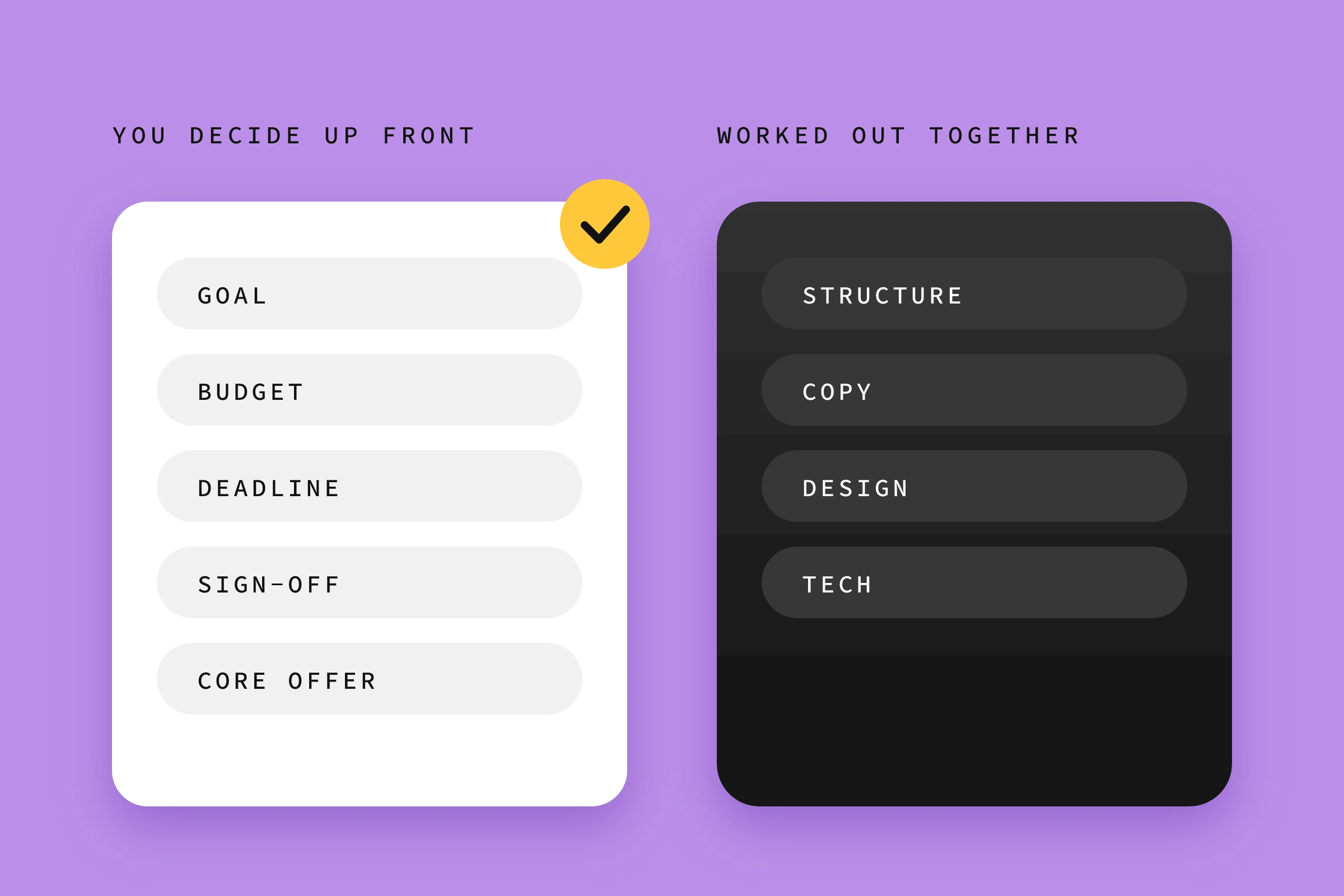
A brief that asks for “eight pages, big slider on the homepage, blog” looks precise. But it answers the wrong question. Whether you need eight pages depends on how many services you have to explain and what your clients are looking for. So describe what visitors should do on the site instead, and leave open how the site achieves it. How your offer and audience turn into a sensible page structure is covered in our article on the topic.
A typical situation in our work is that the client shows us a few example sites and tells us they imagine something like that for their business. In principle, it’s a good thing when clients share examples of sites they like. That helps later with the first draft. It becomes a problem, though, when the examples don’t fit the client’s target audience at all. Of course the new site should appeal to the client too, but the target audience always comes first, not the client. The website has a job, and that job is usually to sell. To sell to the target audience.
Which questions should you ask web designers to compare quotes?
Ask every provider the same questions, specifically about the services that are most often missing from quotes or mean different things: concept, copy, revision rounds, your input, timeline and the period after launch. The answers show you whether two quotes describe the same project.
- Is a strategy or concept phase included, and what does it produce?
- Who writes the copy, and what if I write it myself?
- How many revision rounds are included?
- What do you need from me, and by when?
- How long will the project take if I deliver on time?
- Who owns the domain, logins and content after the project?
- What happens after launch: measurement, maintenance, support?
- With my budget, what would you leave out or do later?
Behind the first question is the strategy work that comes before design. Our guide to the website concept describes what it looks like. Many people underestimate the fourth question. Every website needs input from the client, and the provider knows best which. If you ask early, you can plan your own time before the project plan demands it. The last question also shows you whether the provider prioritises in your interest or just makes the quote fit.
What will a web designer need from you during the project?
During the project, the provider needs material, access, quick and bundled feedback and one person who makes decisions. None of this needs to be worked out in the brief. But if you know beforehand what’s coming, the project won’t stall on your side.
Material means what you already have: your logo as an original file, photos with clear usage rights, approved client testimonials, your existing copy. Testimonials need the longest lead time because they depend on other people. For access, it’s worth checking whose name your domain is registered in and whether your emails run through it. Which content is newly created during the project and who delivers it by when, you’ll agree together later.
Template: your website brief in ten questions
With these ten questions, you can write a brief you can send to any provider. Answer each in one to three sentences. If you can’t answer something, write it down as an open question instead of deleting the line.
- Why do you want to change or rebuild your website now?
- Three months after launch, how will you know it was worth it?
- Who should enquire through the website, and with what problem do these people come to you?
- Which offer should take centre stage?
- Which other services, languages and features does the site need?
- Which websites do you like, what exactly do you like about them, and would they appeal to your clients?
- What budget range have you planned?
- Is there a fixed deadline, and why?
- Who decides, and who has a say?
- What already exists: logo, photos, copy, domain, tools?
Send every provider the same text and the same comparison questions from the previous section. You’ll then end up with quotes you can lay side by side.
Frequently asked questions about the website brief
How long should a website brief be?
Short enough for a provider to read in a few minutes, and complete enough that they have no fundamental questions afterwards. With the ten questions from the template and short answers, you’ll usually manage with one to two pages. It gets longer if you need to describe several target groups or services.
Do I need finished copy before I contact web designers?
No. The brief only needs to say which copy already exists and whether you want to write the new copy yourself. New copy is best written once target audience, message and page structure are clear. If you write it beforehand, you often end up writing it twice.
What if I don’t know my goal or target audience exactly yet?
Write exactly that in the brief. An honest gap is more valuable to a provider than a guessed answer, because they then know the project has to start with clarification. Check in the quote whether this work is planned in or whether the provider wants to jump straight into design.
Should I send the brief to several web designers?
Yes, if you seriously want to compare. What matters is that everyone gets the same text and the same questions, otherwise you’re comparing different assumptions again. Only send it to providers you can genuinely picture working with after looking at their work, because every quote also costs you time to read and follow up.
Conclusion
A website brief makes sure you compare quotes that describe the same project, and that your project starts with the right questions. You decide the goal, budget range, deadline and responsibility; everything else you work out with your provider. Take the ten questions from the template and answer the first three today, while the reasons for your project are still fresh in your mind. For the current situation, an outside view helps: our free website check shows you where your current site is losing enquiries.