Workflow automation with tools like Zapier, Make or n8n means that a defined event triggers an equally defined chain of actions without you having to step in. That works brilliantly as long as every step is clear-cut. It gets tricky as soon as a decision comes up that can’t be squeezed into an if-then rule. That’s exactly where the field begins in which AI agents now do things differently from classic automation. I’ve been building both for years and see the same moment in almost every project: the point where the workflow hits a wall.
Key takeaways
- Classic workflow automation (Zapier, n8n) reaches its limits as soon as a decision comes up that doesn’t fit a fixed if-then rule.
- The most common breaking points are unstructured inputs – free-text emails, changing PDF layouts, ambiguous enquiries.
- AI agents are different because they can interpret context and decide for themselves within a defined framework, instead of just working through predefined rules.
- Realistically, AI agents today are strong at understanding and classifying, but they’re not the solution for complex, multi-step processes without oversight.
- For most SMEs, a combination pays off: the classic workflow remains the foundation, and the AI agent takes over the decision points in a targeted way.
What distinguishes classic workflow automation from AI agents?
A classic workflow works through a hard-coded chain: trigger, condition, action. It does exactly what you set up – no more, no less. An AI agent, by contrast, is given a goal and a framework, interprets the specific situation and decides for itself, within that framework, which step makes sense next.
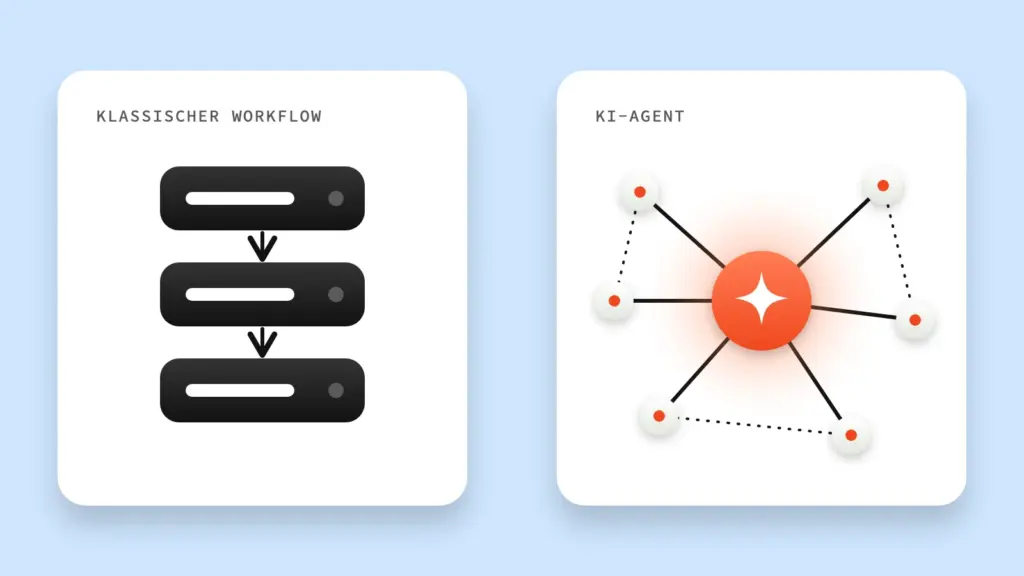
The difference sounds abstract but is simple in practice. A workflow checks: “Does the subject line contain the word ‘invoice’? Then move the email to the Accounting folder.” An AI agent reads the email, understands that its content is an invoice even if the word appears nowhere, and makes the same decision based on understanding instead of a keyword.
In summary, the two approaches differ in how they work, their strengths, their limits and how they’re operated:
| Classic workflow | AI agent | |
|---|---|---|
| How it works | Fixed if-then chain | Goal + framework, decides independently |
| Strength | Clear-cut, repeatable steps | Free text, context, exceptions |
| Limit | Unstructured inputs | Autonomous multi-step processes |
| Costs & operation | Cheap, traceable | More expensive, needs checkpoints |
Where exactly do classic workflows reach their limits in practice?
Classic workflows typically fail in three places: unstructured inputs, exceptions and multi-step decisions. As soon as a process no longer fits neatly into “if X, then Y”, you either need more and more rules – or a system that interprets for itself.
In concrete terms: a customer enquiry arrives as a free-text email, sometimes polite, sometimes curt, sometimes with three questions in one sentence. A supplier invoice comes as a PDF, but every supplier uses a different layout. A form is filled in, but a required field is missing and the route for that was never defined. In theory you could build another rule for each of these cases. In practice, the workflow then grows into a rulebook that at some point nobody fully understands any more – not even you, after a few months.
What can AI agents realistically do today?
AI agents today are good at understanding unstructured content and deriving a well-founded decision from it within a clearly defined framework. They read free text, recognize intent and context, and choose the right option from a defined set – without you having to program every possible wording in advance.
That’s the real progress: you no longer define every exception individually, but give the agent a goal, context and limits. It fills in the rest with understanding instead of rigid rules. For classifying enquiries, pre-checking documents or the initial triage of support tickets, this now works reliably enough for productive use – provided the framework is set cleanly and there’s a control instance for borderline cases.
Where are AI agents (still) not the solution?
AI agents are not a solution for completely autonomous, multi-step processes without any oversight – and that’s explicitly not a footnote but the most important point in this article. The more consecutive decisions an agent makes without feedback, the greater the risk that a single mistake runs through the whole process – a pattern research describes as cascading errors (Zhu et al., 2025).
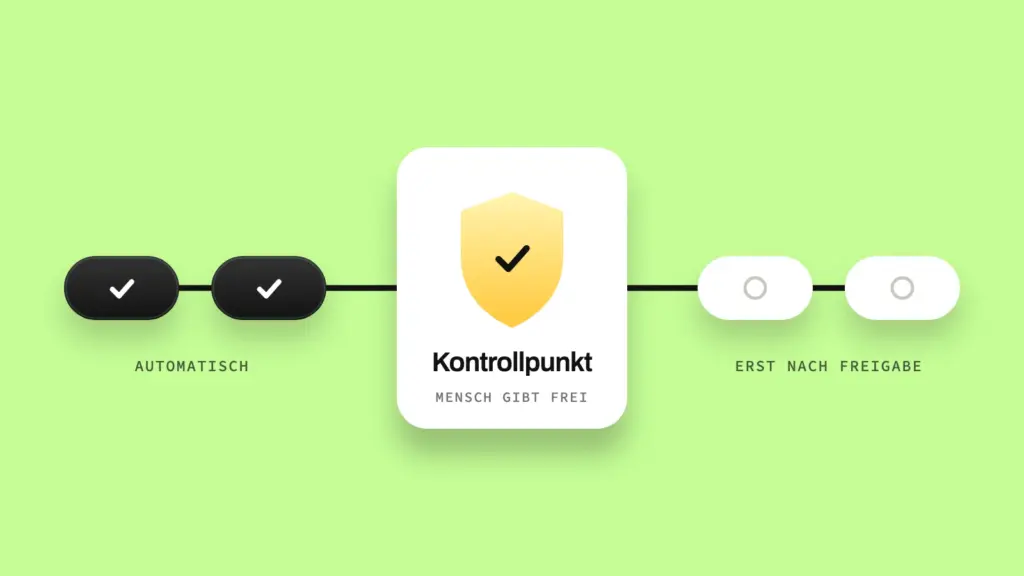
For high-risk tasks too – legally binding commitments, payment approvals, anything with a direct impact on customers – a human still belongs in the loop. Not on principle, but because an agent can be wrong without noticing. Language models tend to fill gaps with plausible-sounding but false content – so-called hallucinations (Ji et al., 2023) – and they do so with the same confidence as with correct answers, because common training methods reward guessing more than admitting uncertainty (Kalai et al., 2025). Anyone who sets up AI automation properly therefore builds in checkpoints deliberately instead of letting the agent run completely on its own. That’s not a sign of immature technology, just good process architecture.
How do you combine classic workflows and AI agents sensibly?
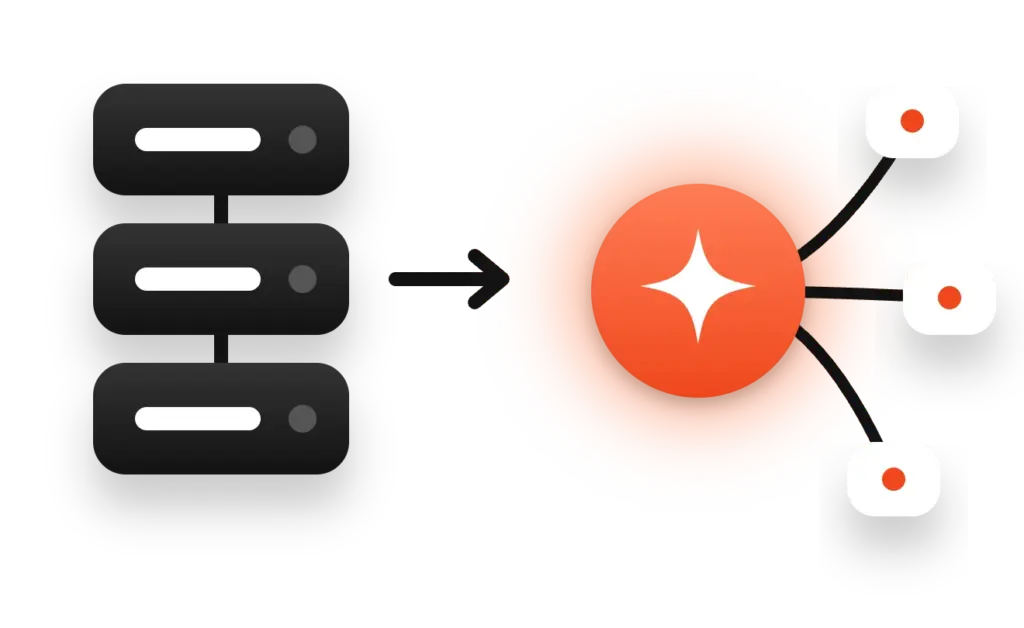
In most cases, the classic workflow remains the backbone – reliable, traceable, cheap to run. The AI agent is added in a targeted way where the workflow previously failed: interpreting free text, classifying ambiguous cases, decisions that used to need a manual check by you or your team.
That means: you don’t replace your n8n workflow with an AI agent. You build the agent into the existing workflow as one building block, exactly at the point where the rule used to be missing. This order matters – first process clarity, then the right tool. Anyone who does it the other way round and buys an AI tool first and then looks for a use case burns time and budget in the wrong place.
Frequently asked questions about classic workflows and AI agents
Do AI agents replace Zapier and n8n?
No, in most cases they don’t. AI agents rarely replace the entire workflow; instead they take over the decision points where rigid rules used to fail. The classic workflow remains the reliable backbone, and the agent is added as an extra building block.
When is an AI agent worth it instead of a classic workflow?
An AI agent is worth it as soon as a process step needs interpretation that can’t be captured cleanly in if-then rules – for example with free-text input, changing document formats or frequent exceptions. If the step can be solved clearly with rules, the classic workflow remains the cheaper and more robust choice.
Do I need programming skills to use AI agents?
Not necessarily. Many AI agents can now be integrated via existing automation platforms such as n8n without writing code yourself. More important than programming skills is a clearly defined framework: setting the agent’s goal, context and limits cleanly.
Conclusion
Classic workflows and AI agents aren’t an either-or but two tools for different tasks. The workflow handles the clear-cut reliably and cheaply; the agent takes over where interpretation is needed – within narrow, deliberately set limits. Before you consider which tool to use, it’s worth asking at which specific point your current workflow actually reaches its limits. Exactly there, and nowhere else, an AI agent makes the difference.